From Trade Wars to Cyber Wars: How Tariffs and Export Controls Are Reshaping the Threat Landscape
Author: Marie Strawser, UMSA Managing Director
February 19, 2026
 When most people hear about tariffs, they think economics. Import costs. Trade deficits. GDP. But in 2026, the conversation has shifted — because the ripple effects of trade policy are now landing squarely in the world of cybersecurity, and most businesses aren’t prepared for it.
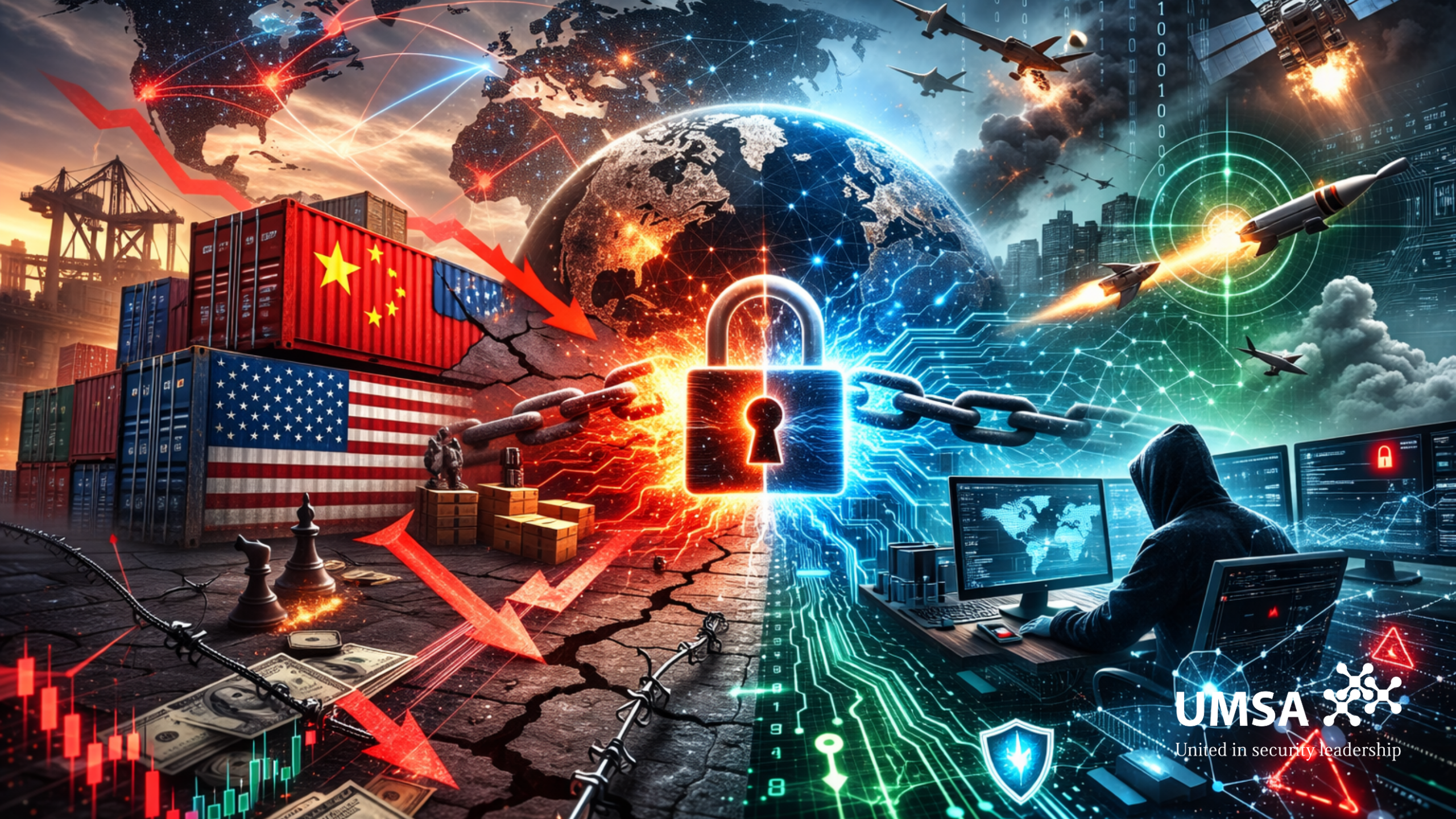
The World Economic Forum’s (WEF) Global Cybersecurity Outlook 2026 put it plainly: the shift toward greater global confrontation — through trade policies such as tariffs and export restrictions — is reshaping alliances and technology dependencies and contributing to a growing fragmentation of global technology ecosystems. What does that actually mean for your company? More than you might think.
The Supply Chain Squeeze
Let’s start with the most immediate impact: your supply chain just got a lot more complicated.
When tariffs hit critical technologies — such as semiconductors, secure routers, and cloud infrastructure — organizations are forced to rethink vendor relationships and sourcing strategies almost overnight. But speed and security rarely go hand in hand. The rush to establish alternative suppliers often outpaces the cyber due diligence that should accompany them. Every new vendor introduces a new digital interface, a new set of risks, and often, a new jurisdiction with entirely different data protection standards.
The numbers tell the story. According to the WEF’s research, over half of large organizations already cite supply chain complexity as their biggest barrier to cyber resilience. Now add tariff-driven disruption on top of that, and you have a recipe for expanded attack surfaces.
It’s not theoretical, either. Companies scrambling to shift suppliers may bypass security reviews to avoid tariff-related delays. Organizations are extending refresh cycles on security appliances to cut costs, which means older, less secure systems staying in production longer. And the counterfeit hardware risk — once a niche concern — is growing as businesses hunt for cheaper alternatives.
The Semiconductor Battleground
Of all the industries caught in the crossfire, semiconductors may be the most consequential — for cybersecurity and national security alike.
 The U.S. has been tightening export controls on advanced chips to China for several years now. In January 2026, the Bureau of Industry and Security revised its licensing posture for high-performance chips like NVIDIA’s H200 and AMD’s MI325X, shifting from blanket denial to a case-by-case review. Simultaneously, a 25% tariff on covered semiconductor imports took effect — a move designed to protect domestic manufacturing but one that sends shockwaves through every part of the technology ecosystem.
Here’s the irony: these restrictions were meant to slow China’s technological rise. But the chip shortage appears to have done something different — it forced Chinese engineers to innovate. China is now filing more semiconductor patents than any other country, and its AI capabilities have advanced faster than many expected, partly because necessity drove creative engineering solutions. The export controls meant to contain the threat may have inadvertently accelerated it.
Control of advanced chips and rare-earth minerals — which China dominates the supply of — is increasingly a matter of strategic cyber advantage. Any disruption to that supply chain doesn’t just affect manufacturing; it affects the very tools we use to defend against cyber threats.
When Trade Policy Becomes Cyber Policy
The lines between trade and cybersecurity are blurring in ways that keep CISOs up at night.
Export restrictions aren’t only targeting chips. The U.S. government has imposed new controls on intrusion detection software, surveillance tools, and AI-driven security technologies. This creates a painful paradox: the tools that defenders need to protect against cyber threats are becoming harder to access, collaborate on, and deploy across borders. Penetration testing tools and red-teaming software — the very instruments used to stress-test corporate defenses — could face licensing restrictions that limit their effectiveness.
The FY 2026 National Defense Authorization Act expanded outbound investment restrictions beyond China to include Cuba, Iran, North Korea, Russia, and Venezuela. It broadened controls to cover high-performance computing and hypersonic systems. The scope is widening, and with it, the web of compliance obligations that every global business must navigate.
Meanwhile, the WEF data makes clear that cybersecurity risk management must evolve in tandem with these shifts — treating trade disruptions not as background noise but as active triggers for threat modeling and vendor risk reassessment.
The Cost Reality
 A $50,000 firewall could jump to $77,000 under current tariff pressures. That’s a 54% increase on a single piece of critical infrastructure. Now multiply that across an organization’s entire security stack — endpoints, network appliances, cloud services, monitoring tools — and the budget impact becomes staggering.
And here’s where it gets dangerous: when budgets tighten due to rising costs, cybersecurity investments are frequently the first to be cut. That creates a cascading vulnerability. Even organizations with strong internal defenses become exposed when their data flows through partners and vendors operating with constrained resources. The risk doesn’t stay contained — it propagates through the entire ecosystem.
The average cost of a data breach already sits at $4.88 million. In an environment where organizations are running older equipment, skipping vendor due diligence, and stretching security budgets thin, that number has nowhere to go but up.
What Resilient Organizations Are Doing Differently
Not everyone is caught flat-footed. The WEF’s research identifies a clear pattern among organizations that are navigating this landscape well.
Resilient companies are treating geopolitical risk as a first-class input to their security strategy. Sixty-four percent of organizations are now factoring geopolitically motivated cyberattacks — including critical infrastructure disruption and espionage — into their risk planning. Among the largest enterprises, 91% have adjusted their cybersecurity posture in response.
They’re also investing in intelligence and partnerships. Seventy percent of large employers have increased their focus on threat intelligence, and nearly half have deepened engagement with government agencies. Board-level engagement is another differentiator: 99% of respondents from highly resilient organizations report active board involvement in cybersecurity oversight.
On the operational side, the playbook includes diversifying supply chains without sacrificing security standards, shifting toward cloud-based security tools where possible to reduce hardware dependency, and building redundancy into critical systems before disruption forces the issue.
The Bottom Line
Tariffs and export controls were designed as economic and geopolitical instruments. But in a world where technology underpins everything — from financial transactions to critical infrastructure to national defense — trade policy is, whether we like it or not, now cyber policy.
The organizations that will come out ahead aren’t the ones that ignore this reality. They’re the ones that see it coming and build it into their planning — treating every trade disruption as a potential security event, every new supplier as a new risk, and every budget squeeze as a reason to be more vigilant, not less.
The fragmentation of global technology ecosystems isn’t slowing down. The question isn’t whether your business will be affected. It’s whether you’ll be ready when it does.
Sources: World Economic Forum Global Cybersecurity Outlook 2026; U.S. Bureau of Industry and Security; FY 2026 National Defense Authorization Act; IBM Cost of a Data Breach Report 2024.