
Preparedness Month Reality Check
Author: Marie Strawser, UMSA Managing Director
September 23, 2026
What Ransomware Recovery Actually Looks Like at Hour 1, Day 1, and Week 1
Every September, National Preparedness Month asks organizations to dust off their disaster recovery plans and confirm they still work. For most security and risk teams, that exercise centers on a tabletop: a hypothetical ransomware note appears on-screen, the incident commander calls the meeting to order, and by the end of the two-hour session, the “attack” is resolved with time to spare for lunch.
Real ransomware recovery does not run on a tabletop’s schedule. It’s worth using this Preparedness Month to compare the plan on paper with what happens in the first hour, first day, and first week of a live incident because the gap between the two is where organizations lose the most time, money, and trust.
Hour 1: You Don’t Find Out the Way You Think You Will
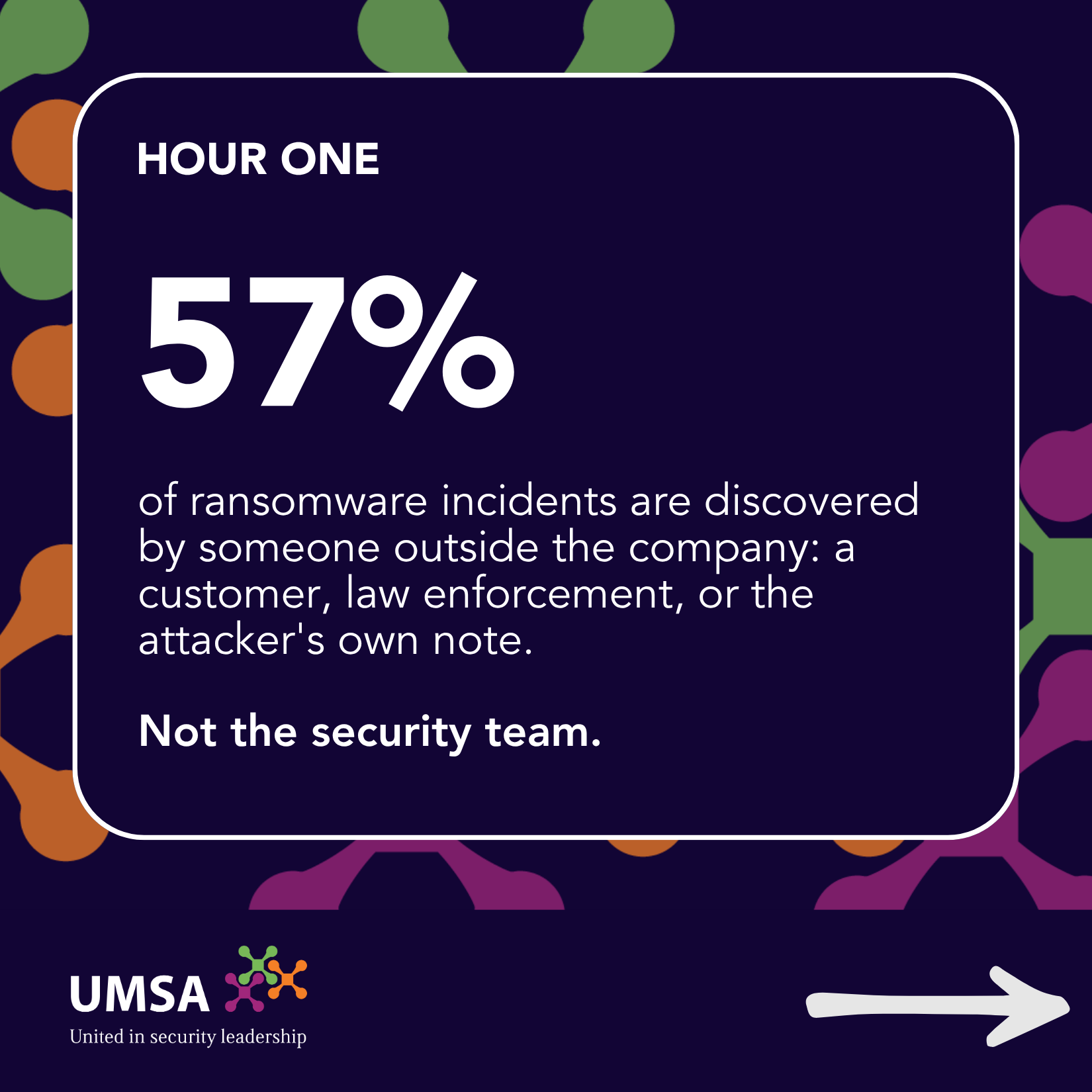
In the tabletop version, the security team detects the intrusion. That’s the exception, not the rule. A majority of ransomware incidents are still identified by someone outside the organization: a customer, a law-enforcement notification, or the attacker’s own extortion message, rather than an internal alert.
According to CNI Solutions’ Ransomware Recovery Statistics 2026 , 57% of ransomware incidents in Q4 2024 were first detected by external parties.
That changes everything about the first hour. There’s no clean “detection triggers investigation triggers containment” sequence, because there was no investigation window to begin with. Attackers increasingly use AI-assisted tooling to compress the time between initial access and business impact from weeks down to hours, and the median gap between an attacker first getting in and deploying encryption is now measured in a handful of days, not the weeks most response plans still assume.
The other hour-one reality: this isn’t primarily a malware problem anymore. Most current ransomware operations get in and move around using stolen or reused credentials, not novel malware, which means isolating a handful of infected hosts doesn’t contain the threat. The attacker may still hold valid access to other systems through an identity that was never flagged. If your plan’s first move is “isolate the affected machines” and stops there, it’s solving last decade’s problem.
What good preparedness looks like here: a pre-built decision tree for who gets called and in what order, with backup contacts, because incidents that do the most damage tend to land on Friday evening or over a holiday weekend, when the fewest people are reachable. And a credential-revocation runbook that’s already written, not improvised, since identity containment is now as urgent as network containment.
Day 1: Two Separate Emergencies, Not One
By the end of day one, most organizations have figured out the scope of what’s encrypted. Far fewer have figured out what was taken, and that second question is now the more expensive one.
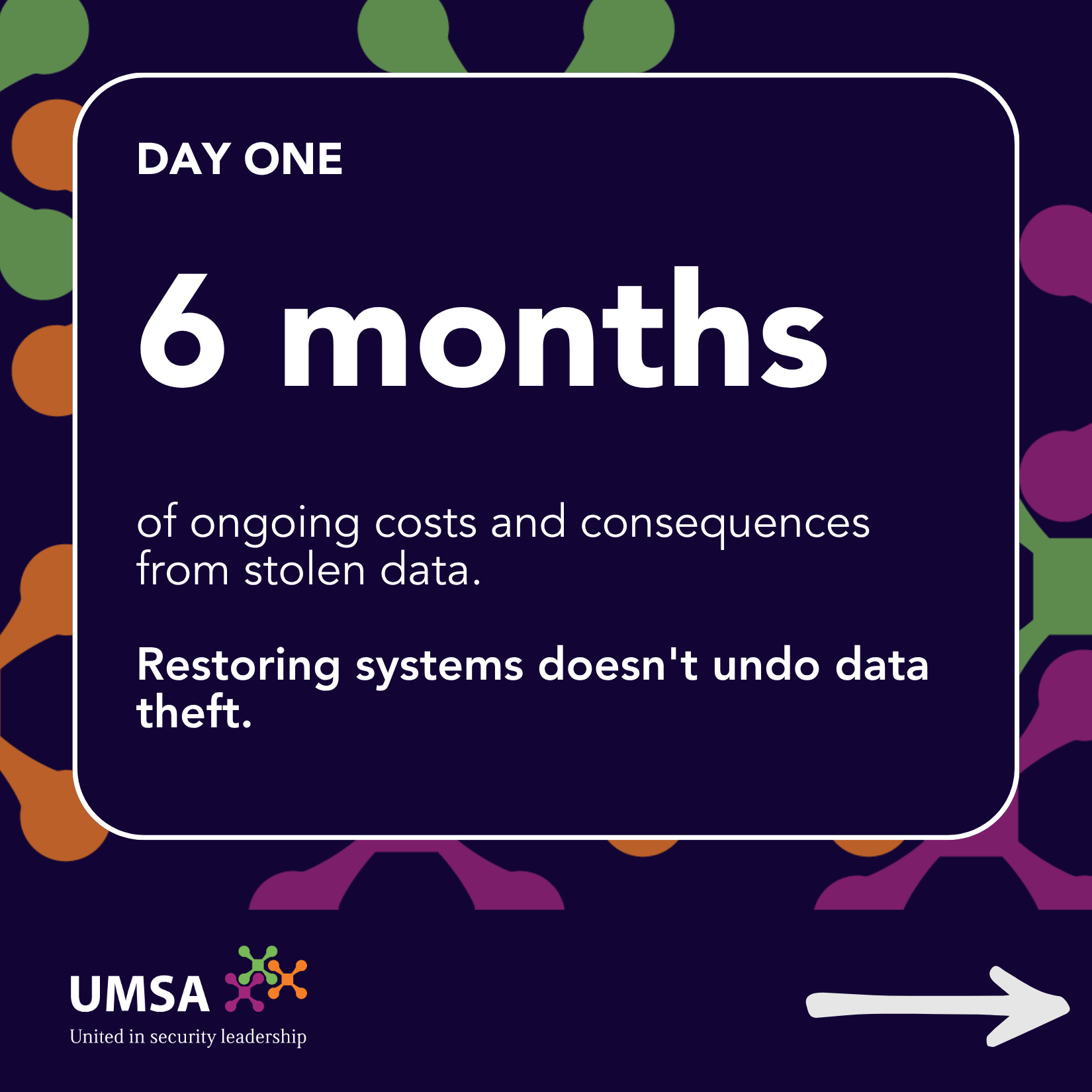
Modern ransomware operators frequently exfiltrate data before they encrypt anything, or instead of encrypting at all. That means a plan built entirely around “restore from backup” solves only half the problem. Even a flawless, same-day restoration doesn’t undo data theft, and it’s the data theft, not the downtime, that typically drives disclosure obligations, regulatory conversations, customer notifications, negotiation dynamics, and the bulk of the cost over the following months.
Sygnia’s Ransomware Incident Response in 2026 describes stolen data as driving disclosure obligations, negotiation, and much of the cost over the following six months.
The six-month timeframe refers to the period in which these costs and consequences can continue, not six months of stolen data.
This is also the point at which the plan’s coordination assumptions are tested. Security, legal, and communications teams need to be making joint decisions within hours: what gets disclosed, on what timeline, in what jurisdiction, using what language, while the security team is still trying to confirm whether containment actually held. Teams that have never run a joint exercise together are, in effect, negotiating their working relationship for the first time during the worst week of their year. Teams that rehearse this together in advance close on decisions in a fraction of the time.
What good preparedness looks like here: a pre-authorized decision framework for ransom-related choices, agreed to before an incident, not argued about during one, because building payment authority and negotiation guardrails in real time is exactly the kind of delay that costs the most when every hour matters. And a joint security/legal/communications exercise on the same calendar as the technical tabletop, not a separate afterthought.
Week 1: Where the Outcomes Actually Diverge
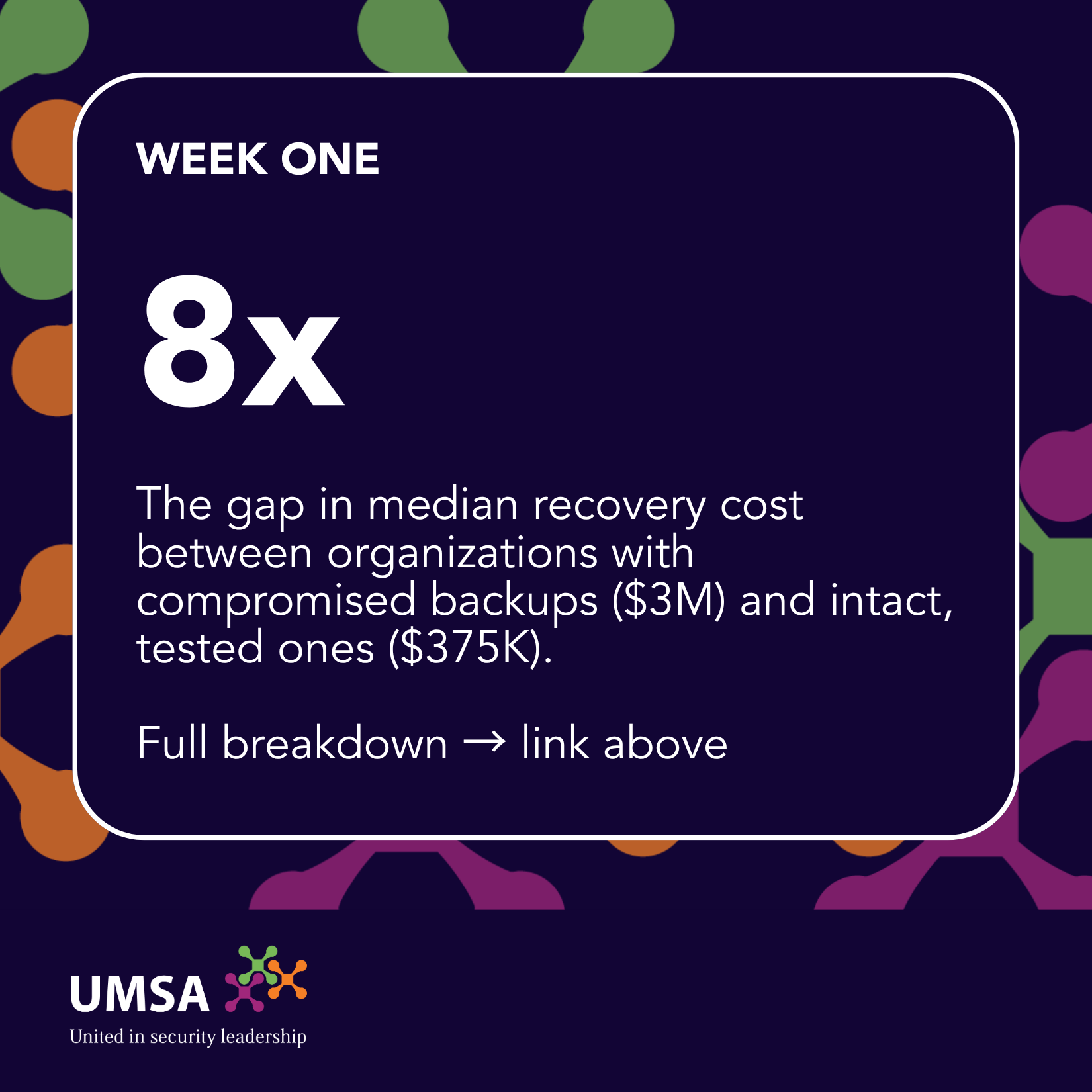
This is where the tabletop-versus-reality gap shows up most starkly in the numbers. Organizations with intact, tested, immutable backups recover for a fraction of the cost of organizations whose backups were compromised or unusable, roughly an eightfold difference in median recovery cost between the two. That single variable, more than almost any other, predicts whether an organization is looking at a manageable week or a multi-month recovery.
According to CNI Solutions’ Ransomware Recovery Statistics 2026 , organizations with compromised backups face a median recovery cost of $3 million, compared with $375,000 for organizations with intact backups.
The encouraging trend: full recovery within a week has become meaningfully more common, driven largely by organizations that invested in tested backups and automated response playbooks in advance. Those with a documented, rehearsed incident response process contain incidents significantly faster than those improvising in real time. The discouraging trend: a meaningful share of organizations still take more than a month to fully recover, and for them, week one isn’t the end of the crisis, it’s the point where the data-theft consequences (notification, regulatory exposure, negotiation, legal cost) are just beginning to compound on top of the operational disruption.
What good preparedness looks like here: backup integrity testing that happens on a schedule, not just after an incident, forces the question because “we have backups” and “we have backups that will actually restore under pressure” are different claims, and only one of them holds up in week one.
The Preparedness Month Takeaway
The plan that survives contact with a real ransomware incident isn’t the one with the most pages. It’s the one that assumes detection will come from an unexpected source, treats identity compromise as seriously as malware, separates the data-theft problem from the downtime problem, and has already rehearsed the cross-functional decisions, ransom authority, disclosure timing, and communications that used to be made under pressure.
This September, the most valuable use of Preparedness Month isn’t running the same tabletop exercise again. It’s pressure-testing the assumptions underneath it: Would your team actually find out the way your plan assumes? Do you have an identity recovery runbook, not just a network isolation checklist? Have legal, security, and communications ever practiced a joint decision under a clock? And when was the integrity of your critical systems’ backups last tested, not just backed up?
Those are the questions worth answering before hour one arrives, not during it.
Sources consulted: Ready.gov — National Preparedness Month, CNI Solutions — Ransomware Recovery Statistics 2026, Sygnia — Ransomware Incident Response in 2026